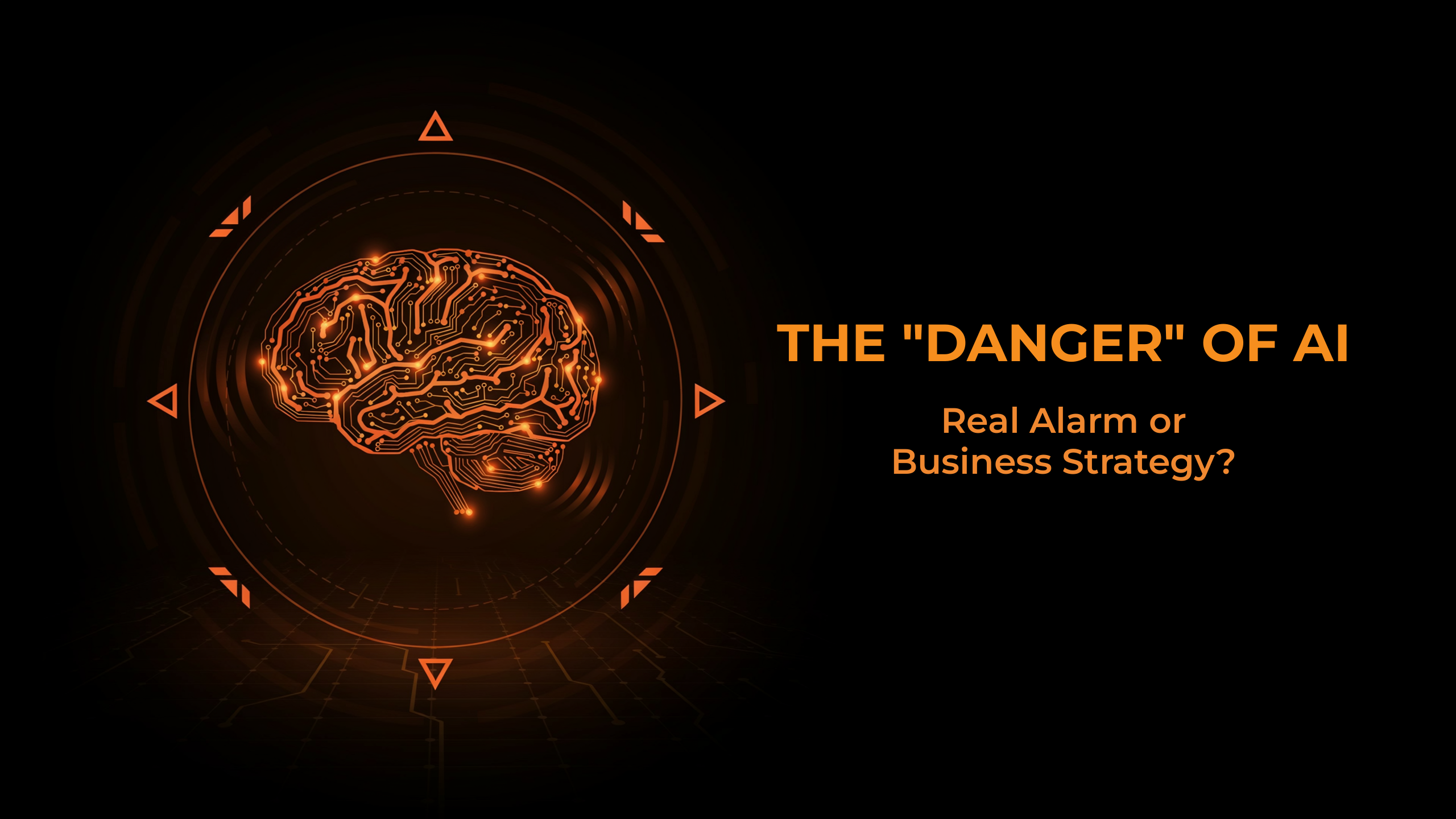
The “Danger” of AI: Real Alarm or Business Strategy?
In mid-September 2026, three of the most powerful men in artificial intelligence came out almost simultaneously to warn — once again — that AI is a danger to humanity and that it must be slowed down. Dario Amodei (Anthropic), Sam Altman (OpenAI), and Elon Musk (xAI) dominated the headlines with a message essentially identical at its core: this is accelerating too fast and something must be done now.
The result was the predictable media panic. But once you separate the statements from the economic and political reality, the story looks quite different.
What they said
Dario Amodei was the one who set the ball in motion. In early September he published an essay calling to slow down AI development to “give safety measures time.” He warned that, within six to twelve months, AI could be capable of directing a “swarm” able to take control of the internet. And he closed with a phrase designed to define the debate: “we owe it to humanity.”
Sam Altman described “two major threats” AI poses to humanity, said we could “lose control of the future to AI,” and declared himself “unambiguously on Team Humanity.” He also testified before the U.S. Senate again, calling for federal oversight.
Elon Musk, the longest-standing voice of the three on this topic, repeated it in its most extreme version: during the trial against OpenAI he declared that AI could “end humanity,” and put the odds of AI “going wrong” at “10% to 20%.”
Three voices, one chorus: AI is dangerous, it must be regulated and slowed down. The detail none of the three emphasizes? That the three of them are, precisely, the ones building it and selling it.
The elephant in the room: the conflict of interest
Let’s lay the picture on the table:
- Amodei runs Anthropic, a company that sells Claude to businesses and governments, and is backed by billions from Amazon and Google.
- Altman runs OpenAI, valued in the hundreds of billions, with Microsoft as its largest partner and IPO conversations on the horizon.
- Musk runs xAI (the direct competitor of the other two), alongside Tesla, and is locked in a legal battle against OpenAI over its future.
That the people who benefit most from the AI boom are also the ones making the most noise about its danger is no coincidence. Alarmism serves them in at least three very concrete ways:
1. The regulatory moat
Calling for “regulation” sounds altruistic, but it has a practical effect: the rules they themselves help write are rules they can comply with — they have the lawyers, the resources, and the compute power. A startup or a new competitor does not. The specialist outlet The Register summed it up without anesthesia: Amodei’s “pacing the frontier” proposal is, in practice, a way to “capture regulators, make more money, and dodge accountability.” There’s even a delicious irony: Anthropic’s regulatory push ended with the company’s own model being vetoed by the U.S. government.
2. Funding and valuation
Fear and enthusiasm are two sides of the same coin for capital: both keep these companies on the front page and keep investors convinced they’re looking at “the most important company in the world.” The telling data point: Musk warned of AI’s “existential risk” exactly when xAI was raising a round that valued it at 40 billion dollars. Altman speaks of the “end of human control” while his company prepares for a possible IPO.
3. Competitive positioning
Each one presents himself as “the responsible one” against the other two. Musk uses the danger warnings as ammunition in his lawsuit against OpenAI, selling himself as the guardian of safety while launching his own Grok. Altman wraps himself in “Team Humanity” to differentiate from “less careful” competitors. Safety has become a sales argument, not an act of philanthropy.
The reality that doesn’t fit in the headline
Does this mean AI has no risks? No. It means the risk they’re selling is not the risk that exists.
There is no evidence of an imminent existential danger. Figures like Musk’s “10% to 20%” don’t come from any scientific model: they’re numbers tossed into the air to generate headlines. The idea of a “swarm of AI taking over the internet” in six months is speculation, not a technical finding. Today’s AI systems are powerful tools, yes, but they have no consciousness, no will, and no agenda of their own. They do exactly what we ask of them.
Altman himself let slip, almost without meaning to, the most real risk of this whole narrative: that fear could lead people to “trade freedom for security.” In other words, that panic becomes an excuse to concentrate even more power in a few hands.
AI’s real risks are far more mundane, and precisely for that reason more manageable: job displacement (Amodei himself acknowledges it), energy consumption, market concentration in three or four companies, copyright, bias, and cybersecurity. None of these require slowing the technology down; they require good public policy, education, and sensible governance.
The political and geopolitical context
The warnings don’t fall into a vacuum: they land in Washington. And there the picture gets complicated. President Trump resists calls to slow AI down — not out of philanthropy, but because slowing down means ceding competitive advantage to China and other actors. Senators like Blumenthal and Cantwell push for more controls. Mark Zuckerberg entered the debate with his own agenda. And Amodei proposes a “global democratic coalition” for AI, which is as much a security idea as a geopolitical move.
The underlying pattern is classic: the regulated want to write the regulation. When industry leaders ask to be regulated, the right question isn’t “how serious is the danger?” but “who benefits from the rule they’re proposing?”
Conclusion: healthy skepticism, not panic
For a business, the lesson is clear and reassuring. AI isn’t the Terminator coming to wipe us out: it’s a productivity tool that is redefining how work gets done, how products are sold, and how customers are served. The “imminent danger” headlined by Amodei, Musk, and Altman is, to a large extent, an instrument of their own commercial and regulatory strategies.
The real risk isn’t that AI destroys you. It’s being left out while others adopt it.
The smartest stance — and the most profitable one — is balanced skepticism: take AI seriously as a tool, evaluate providers with judgment, and look with the same critical distance at those who promise a technological paradise and those who announce the apocalypse.
How to apply AI in your business without falling for the panic
The best antidote to alarmism is informed adoption. At PG Tech, we help Panamanian businesses use AI where it actually delivers measurable value:
- Business Intelligence — turn your data into decisions, with dashboards and accessible analytics.
- Virtual Agents — automate customer service and repetitive tasks without adding headcount.
- Cybersecurity — protect your operation against real risks (fraud, phishing, breaches).
- IT Support — keep your infrastructure stable while you adopt new tools.
Technology doesn’t wait. What matters isn’t whether AI “is dangerous,” but whether your business is using it wisely.
Frequently asked questions
Is AI really a danger to humanity?
There is no evidence of an imminent existential danger. Today’s AI systems are powerful tools, but they have no consciousness, no will, and no agenda of their own. The real risks (jobs, energy, bias, cybersecurity, market concentration) are far more mundane and manageable with good governance.
Why are Musk, Altman, and Amodei calling to slow down AI?
All three run companies that build and sell AI, and alarmism serves them commercially: a “regulatory moat” that only the big players can comply with, a narrative that supports their valuations and investment, and positioning against their competitors. It doesn’t mean the issue doesn’t matter; it means it’s worth reading with judgment.
Should my business stop using AI because of these risks?
No. The greatest risk for a business isn’t that AI destroys it, but falling behind while its competitors adopt it. The sensible approach is to adopt it with judgment: clear use cases, vetted providers, and security and data controls.
Which AI risks actually matter to a business in Panama?
Data loss and AI-enabled fraud (phishing and deepfakes), misuse of confidential information, dependence on vendors, and the displacement of repetitive tasks. All of these are managed with cybersecurity, internal policies, and training — not by slowing the technology down.
Sources consulted: AP News, CNBC, The Atlantic, Fortune, Axios, Reuters, The Register, and Business Insider (September 2026).