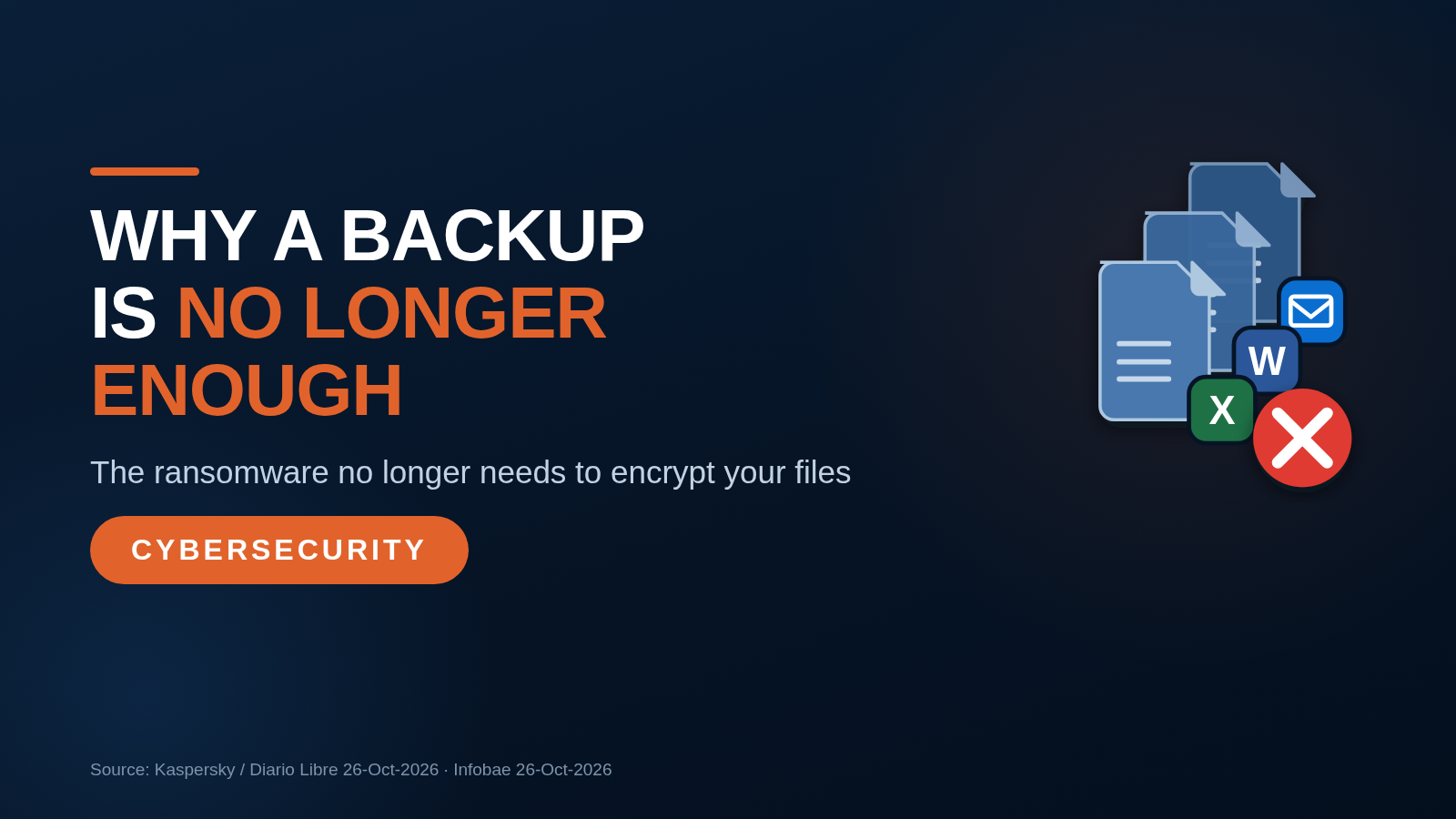
Why a backup is no longer enough: the ransomware that does not encrypt
For years the rule was simple: if you have backups, ransomware is an annoyance, not a tragedy. That rule just expired.
Kaspersky documented an attack in which the criminals did not encrypt a single file and still paralysed the company’s operation. They didn’t need to lock the data: taking away control was enough.
What happened
The case took place in April 2026 at a manufacturing company in the Middle East and was documented by Kaspersky in September. It used a variant of the Payload family. The attackers took control of network configurations, disabled administrator accounts and pushed ransom messages to the organisation’s computers.
Then they exfiltrated corporate information and published it on the dark web.
Read that again: nothing was encrypted. The backup was intact, the files were there, and the company still had to negotiate.
Why a backup is not enough
A backup solves one problem: recovering data when something deletes or locks it. It does not solve the other two.
If your administrator accounts are disabled, you have nothing to restore with. If the network configuration is altered, restoring files does not give you back control. And if data is exfiltrated, the damage is already done: your contracts, your payroll or your customers’ data are out there, and a backup will not bring them back.
Extortion changed currency: you used to pay to regain access, now you pay so they don’t publish what they already have.
The other front: your vendors
On 26 October, The Washington Post reported that a cybersecurity startup entered Anthropic’s internal systems in under 12 hours. They did not get in through the AI model: they got in through the software the company uses to sell and manage people — the same kind of system used by thousands of companies with nothing to do with AI.
They reached meeting transcripts, salaries, job offers and internal Slack messages.
The lesson for a small business is uncomfortable: the weak link is almost never your core system. It’s the SaaS you installed to solve one thing and nobody reviewed again.
What to do this week
Five controls that don’t cost a fortune and do change the outcome:
- Patching on a date, not on intention. A defined monthly window and an owner. Without it, the gap between the patch and your update stays open.
- MFA on every administrative access. The cheapest control and the one that stops the most attacks.
- Review privileged accounts. How many exist, who uses them, which ones should no longer exist.
- Early detection. Without monitoring, you find out when the ransom note is already on the screen.
- Tested backups. Having them is not enough: restore once a quarter and measure how long it takes.
In short
Ransomware stopped being a file problem and became a control problem. The right question is no longer “do I have a backup?” but “how long would it take someone to notice I’m being attacked?”.
If that answer doesn’t exist in your company, get in touch and we’ll review it at no cost.
Sources
- Diario Libre, 26-Oct-2026: Kaspersky warns about ransomware without encryption
- Infobae, 26-Oct-2026: Anthropic hacked in 12 hours
- Bit Life Media, Oct-2026: “Black October” in cybersecurity